Journal · Jun 2, 2026
Stihl MSA 300 C-O — Which Chains Fit Their Flagship Battery Chainsaw
The MSA 300 C-O is Stihl's most powerful battery chainsaw to date. Here is exactly which replacement chains fit and how to pick the right one.
Published
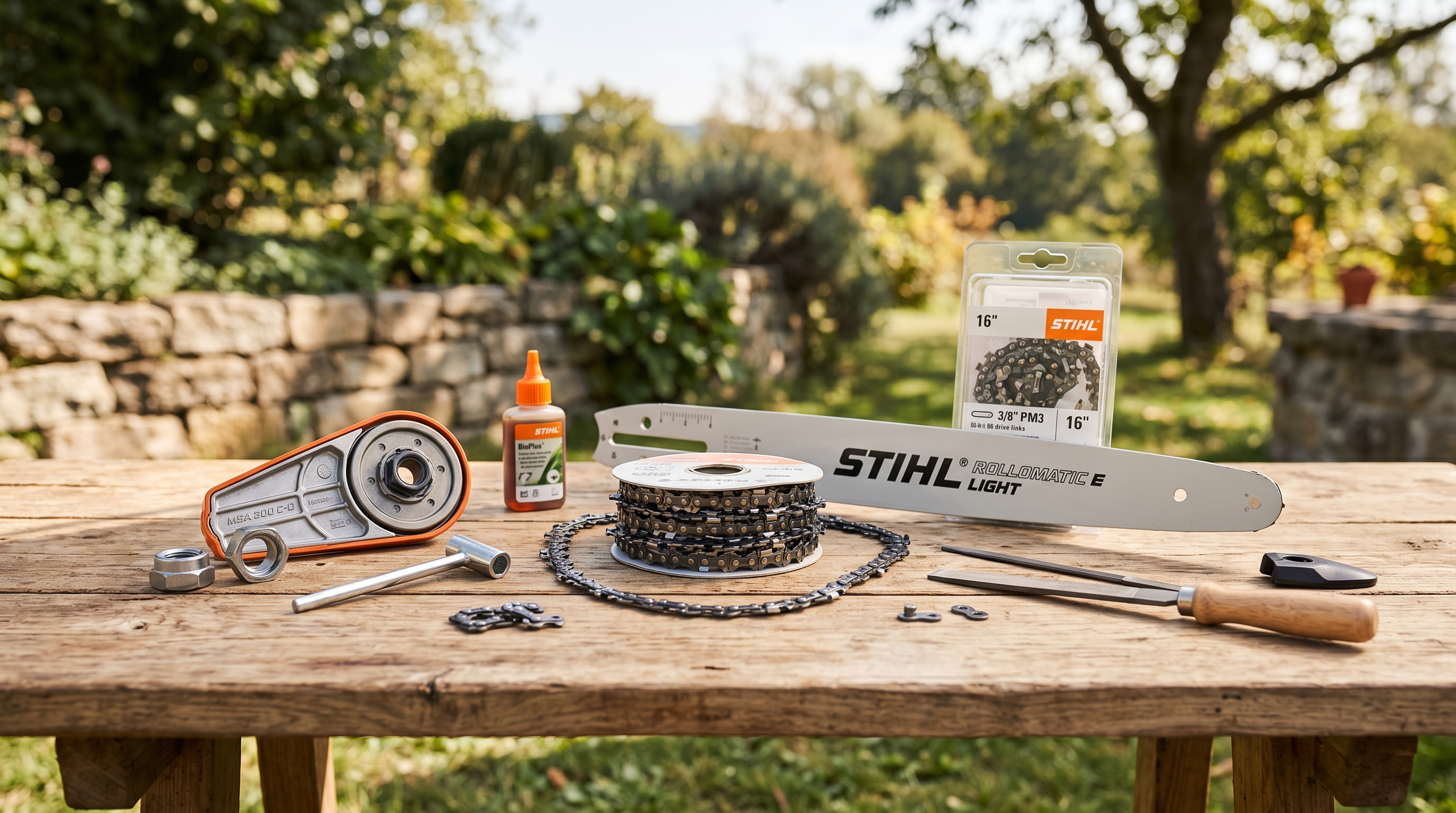
Stihl MSA 300 C-O — Which Chains Fit Their Flagship Battery Chainsaw
Stihl built the MSA 300 C-O to prove that a battery saw can play in serious pro territory. This is not a light-duty homeowner machine dressed up with a premium price tag. It is Stihl’s most powerful battery chainsaw, built around the AP battery system, and positioned to compete with roughly 40cc-class gas saws in real cutting work. For users already familiar with pro-grade chain selection, the most important detail is also the one most likely to cause confusion: the MSA 300 C-O does not use the small low-profile chain commonly found on earlier Stihl battery saws.
It uses full-size 3/8” pitch chain.
That single fact changes the replacement conversation completely.
The key compatibility point: full-size 3/8”, .050” gauge
The stock chain on the MSA 300 C-O is typically specified as Stihl Rapid Micro (RM) or Stihl Rapid Super (RS) in 3/8” pitch and .050” gauge (1.3 mm), depending on bar package and market configuration. The critical technical point is that this is standard full-size 3/8” chain, not 3/8” Picco, not 3/8” P, and not low-profile chain.
That distinction matters because many users associate Stihl battery saws with Picco setups. On most earlier battery platforms, that assumption was correct. On the MSA 300 C-O, it is not.
If you are buying replacement chain for this saw, the fitment basics are:
- Pitch: 3/8”
- Gauge: .050” / 1.3 mm
- Drive link count: depends on bar length
If those three specifications match your bar, the chain will fit regardless of brand.
Drive link counts: 14-inch and 16-inch setups
For the MSA 300 C-O, the common factory bar lengths are:
- 14” bar = 50 drive links
- 16” bar = 55 drive links
Those are the standard counts most buyers will encounter, but experienced users already know the final authority is the bar stamp. Bars can be swapped, and drive link count is bar-specific, not saw-specific in isolation. Before ordering chain, read the markings stamped on the guide bar and confirm:
- pitch
- gauge
- recommended drive link count
That verification step matters especially with a saw like the MSA 300 C-O, because many owners are moving into full-size 3/8” battery setups for the first time and may still have older Picco assumptions in mind.
Why the MSA 300 C-O is different from earlier Stihl battery saws
The MSA 300 C-O is historically important in Stihl’s cordless lineup because it is the first Stihl battery chainsaw to use full-size 3/8” pitch chain. Earlier Stihl battery saws typically ran 3/8” P (Picco) chain, which is narrower, lower-profile, and optimized for lower power output, lighter weight, and smoother cutting on smaller saws.
The MSA 300 C-O breaks from that pattern because it is designed for higher chain speed, heavier-duty cutting, and a more direct challenge to professional gas saws. Full-size 3/8” chain offers greater cutter mass and durability in demanding work, and it aligns better with the saw’s intended use in felling, bucking, and larger-diameter wood.
For chain buyers, the takeaway is simple: do not order Picco chain for an MSA 300 C-O unless you have deliberately changed to a different compatible bar/sprocket system. In stock form, this saw is a full-size 3/8” machine.
OEM chain types: Rapid Micro vs Rapid Super
Stihl’s own chain options for this saw generally fall into two familiar categories:
- Stihl Rapid Micro (RM) — semi-chisel
- Stihl Rapid Super (RS) — full chisel
Both are available in 3/8” pitch, .050” gauge configurations suitable for the MSA 300 C-O.
For users cross-shopping aftermarket replacements, the practical equivalents are any chains matching the same dimensional specs. That includes replacement options from major aftermarket manufacturers such as Oregon and Carlton, provided they are:
- 3/8” pitch
- .050” gauge
- 50 DL or 55 DL, depending on your bar
In other words, you are not locked into Stihl-branded loops. If the chain matches the bar and sprocket specifications, it fits.
Aftermarket equivalents: what to look for
When shopping aftermarket, ignore branding first and focus on geometry. The MSA 300 C-O will accept any standard 3/8” .050” chain with the correct drive link count. That opens the door to common Oregon- and Carlton-pattern loops in both semi-chisel and full-chisel designs.
Typical aftermarket categories include:
- Semi-chisel 3/8” .050”
- Full-chisel 3/8” .050”
- Low-kickback or safety variants, if desired
- Professional non-safety chain, for experienced users
For an experienced operator, the main decision is not whether an aftermarket chain will fit, but which cutter profile best suits battery power delivery and working conditions.
Full chisel or semi-chisel on a battery saw?
On paper, full-chisel chain cuts faster. In clean wood, that remains true on the MSA 300 C-O. A chain equivalent to Stihl RS is the right choice when maximum production matters and conditions are clean.
But for many users, semi-chisel is the better all-around option on a battery saw.
Why? Because semi-chisel stays sharp longer, especially in dirty bark, frozen wood, storm cleanup, or mixed hardwood conditions. That matters even more on a battery machine. While the MSA 300 C-O is powerful, it still has less brute-force recovery than a larger gas saw when cutters become marginal. A semi-chisel chain equivalent to Stihl RM tends to maintain acceptable cutting performance longer between sharpenings and asks slightly less from the powerhead when conditions deteriorate.
For many real-world battery users, that tradeoff makes sense:
- Full chisel for clean timber and maximum speed
- Semi-chisel for durability, consistency, and longer edge life
Why chain tension matters more on battery saws
Chain tension is always important, but it becomes especially critical on high-output battery saws like the MSA 300 C-O. Gas saws naturally fluctuate in RPM under load and through throttle transitions. Battery saws, by contrast, tend to deliver more consistent chain speed and torque characteristics through the cut. That steady pull exposes poor tension setup quickly.
A loose chain on a battery saw can:
- derail more easily
- hammer the drive links and bar rails
- wear the bar nose faster
- reduce cutting efficiency
- create uneven cutter engagement
An over-tight chain is no better. It increases drag, reduces runtime, builds heat, and accelerates wear on the bar, chain, and drive system.
Because the MSA 300 C-O holds chain speed so consistently, proper tension has a direct effect on both performance and battery efficiency. Check tension often, especially during break-in on a new chain.
How to verify fitment correctly
For the MSA 300 C-O, correct fitment comes down to a simple checklist:
- Read the bar stamp
- Match the pitch
- Match the gauge
- Match the drive link count
For stock setups, that usually means:
- 3/8” pitch
- .050” gauge
- 50 DL for 14”
- 55 DL for 16”
That is the standard. But the bar stamp is always final.
The bottom line: the Stihl MSA 300 C-O uses full-size 3/8” .050” chain, making it a notable departure from earlier Stihl battery saws. Whether you choose OEM Rapid Micro or Rapid Super, or aftermarket Oregon or Carlton equivalents, any properly matched 3/8” .050” loop in the correct drive link count will fit. For experienced users, the real decision is cutter style—not compatibility.
Find the right part on Amazon
Check price, stock and fitment — ships direct from Amazon.
Parts